

Dharashiv rains fail farmers, collector's report warns of major kharif crop crisis
A collector's report says nearly 95 percent of Dharashiv's kharif crop area is under acute moisture stress after August and September rainfall failed.
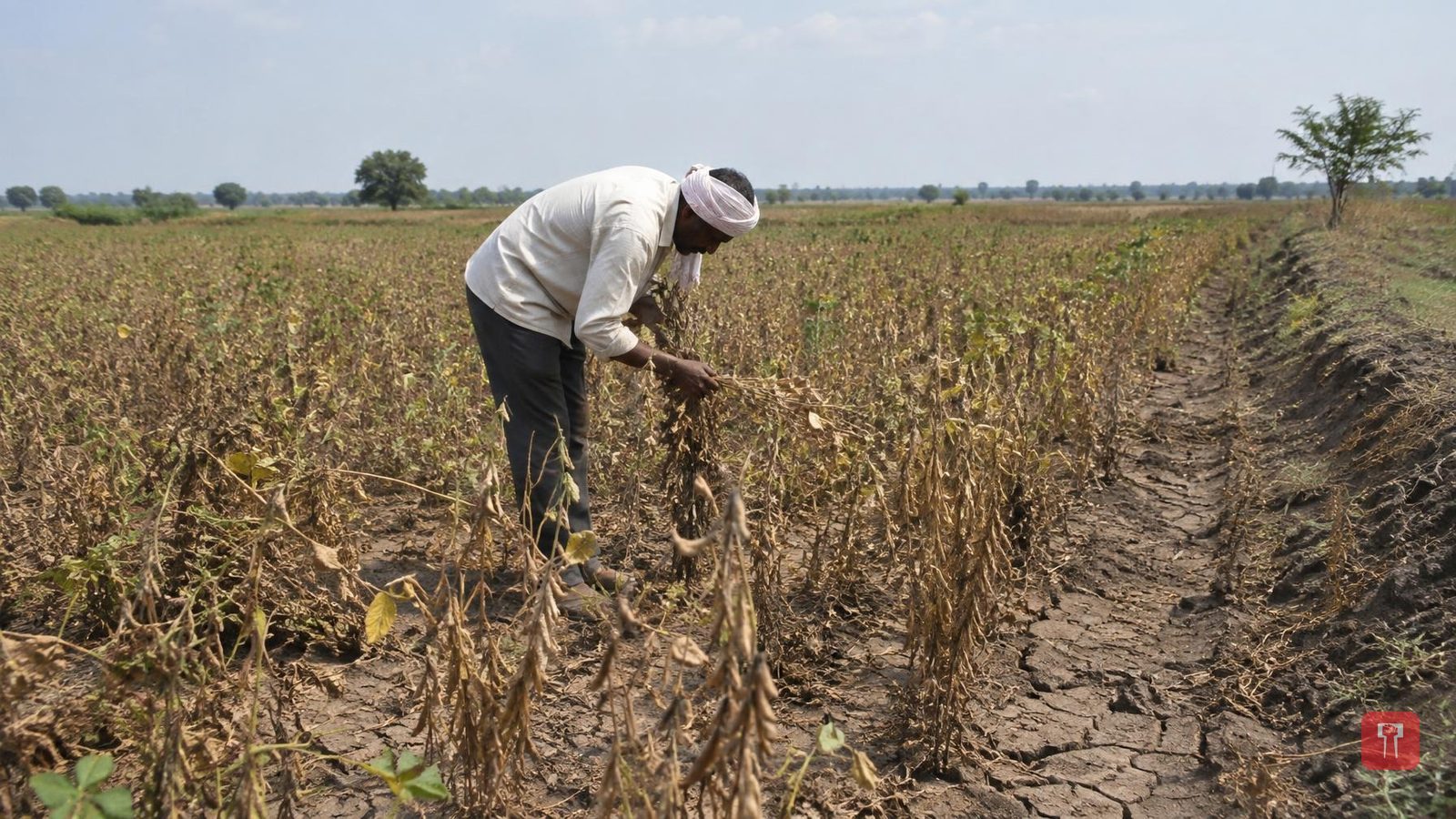
Erratic rainfall this year has undone the hard work of farmers in Dharashiv district. Rain was reasonably good in June and July, but suddenly vanished in August, and September has seen the same pattern. According to a brief report by District Collector Kirti Kiran Pujar, nearly 95 percent of the kharif-sown area in the district is under acute moisture stress, and more than 80 to 85 percent of crops are feared to be damaged. Crops have dried up and reached a stage of premature ripening, so even if rain falls now, there is very little scope left for yields to improve.
Dharashiv district's average rainfall is 603.10 mm, but the pattern has been erratic from the start this year. June recorded 97.60 percent of the average and July recorded 100.10 percent, but rainfall suddenly turned away in August. Only 43.1 mm, or 27.90 percent, was recorded that month. The situation did not change in September either, with just 6.8 mm, or 3.7 percent, recorded till September 14. As a result, rainfall between June and September 14 was 48.49 percent below average.
In August, different parts of the district saw continuous rainfall gaps of 29 to 35 days. In September too, rain was absent for 7 to 12 days. According to records from 45 of the district's 57 revenue circles that have automatic weather stations, there were 22 dry days in June, 12 in July, 29 in August and 17 in September. Between June and September, there were 80 rainless days in all, depleting soil moisture during the most crucial period of crop growth.
This year, kharif sowing in the district covered 5,39,027 hectares, of which soybean accounted for 4,67,322 hectares, or 86.70 percent. This was followed by tur on 34,831 hectares, urad on 21,886 hectares and moong on 5,544 hectares. The prolonged dry spell has hit soybean and urad crops on light soils the hardest. In many places, crops have dried up completely, and farmers are pulling out soybean plants to feed them to livestock as fodder. Crops on medium to heavy soils have also been badly affected at the flowering, pod or ear formation, and grain-filling stages.
The report clearly states that the prolonged absence of rain has caused acute moisture stress in crops, and nearly 95 percent of the area's crops have dried up and reached premature ripening. Beyond this stage, even if rain falls, there is limited scope for the crop's biological growth and yield components to recover. In other words, even future rainfall is unlikely to make up for the loss in yield already suffered.
According to an assessment by MNCFC cited in an IIT Bombay report, the district's rainfall status between June 1 and August 21 was in the "deficient" category (-20 to -60 percent), while between August 6 and August 21 it fell into the severe "scanty" category (-60 to -100 percent). The Moisture Adequacy Index also showed that soil moisture conditions were poor across different taluks.
Along with the crop crisis, the state of water storage in the district is also a growing concern. The district has 225 water projects in total, large, medium and small, with a combined usable water capacity of 725.40 million cubic metres, but only 55.030 million cubic metres, or eight percent, of water currently remains. According to records from 114 monitoring wells of the groundwater development agency, the average groundwater level in September 2026 is 9.53 metres, which is 7.02 metres lower than the average of the past five years. This raises fears of a worsening drinking water crisis in the period following the kharif season.
With crops at risk of being lost to lack of rain on one hand, and dwindling water storage and falling groundwater levels on the other, farmers in the district are caught in a double crisis. On September 2, the administration had directed university scientists, tehsildars, taluka agriculture officers, IIT Bombay representatives and progressive farmers to jointly inspect crops directly in at least two villages in every revenue circle and submit reports. These inspection reports have revealed that the uneven distribution of rainfall, long gaps and low rainfall in August have left kharif crops in a serious condition. As a result, providing relief to farmers based on actual losses, rather than relying solely on the hope of future rain, has become a major challenge before the government and the administration.
This story has published but the live thread has not started. Updates appear here the moment the desk files one.
