

Mira Road school's onion-garlic tiffin ban for Jain festival sparks row
A Mira Road school's circular banning onion, garlic and root vegetables from tiffins during the Jain festival of Paryushan has triggered a political and social controversy.
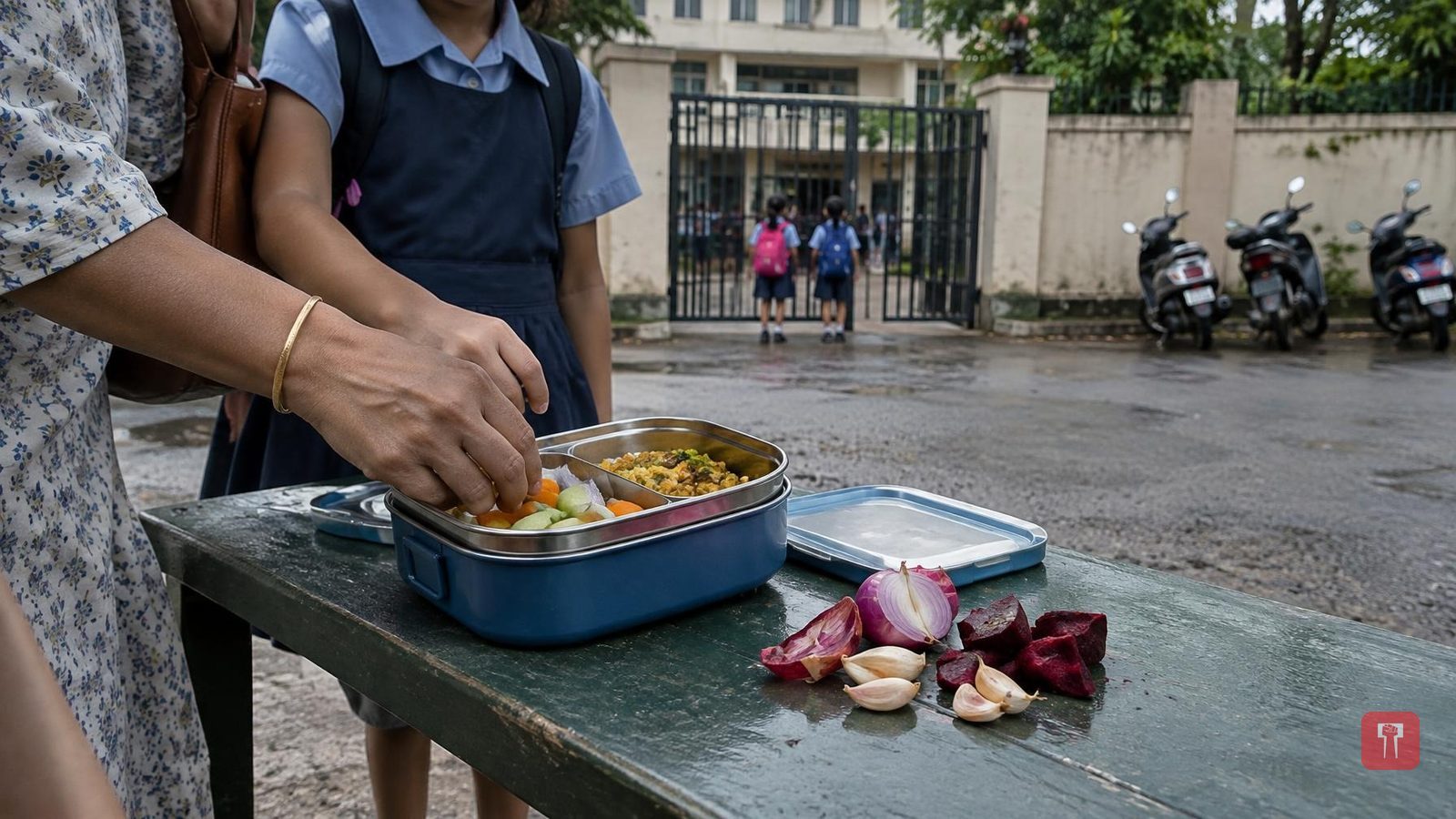
A school is not just a place of study within four walls; it also teaches the first lesson in equality and respect for one another's thinking. But when an educational institution starts deciding what should and should not be in children's tiffins in the name of a religious festival, it raises questions about the very purpose of education. The well-known Seven Square Academy in Mira Road has issued a circular for the occasion of the Paryushan festival that has stirred a sharp debate in Maharashtra on this sensitive issue. At the centre of the controversy is a clash between freedom of food choice, religious practice and administrative strictness.
The dispute is that Seven Square Academy in Mira Road has issued a special circular ahead of the Jain festival of Paryushan. According to the directive, all children at the school are strictly barred from bringing onion, garlic, beetroot, potato and other root vegetables that grow underground in their tiffins until September 16. Notably, the rule is not limited to children's tiffins alone; the school has also made clear that such items will not be available in the school canteen during this period.
Local residents say the school is privately owned by BJP's local MLA Narendra Mehta and his family, which is why the decision is being seen as an attempt to forcibly impose religious practice. Opposing the decision, the Maharashtra Navnirman Sena (MNS) has taken an aggressive stance, lodging a complaint with education officials and demanding strict action against the school. The question now being raised is who gave the school administration the right to impose such a direct ban on children's food.
Paryushan holds a very sacred and spiritual significance in Jainism. During this festival, a message of compassion, kindness and non-violence towards all living beings is conveyed. The religious purpose behind avoiding root vegetables is to prevent harm to the microscopic organisms present in the soil. There is no disagreement that this festival and the thinking behind it deserve respect. It is a good thing if a school makes some effort or creates an atmosphere that is mindful of Jain children's sentiments.
But the question is how right it is, while respecting the religious customs of one section, to curtail the personal freedom of children of other faiths or differing views. In a vast country like India, equal respect for all religions is our identity. In such a case, forcibly applying the rules of one particular religion to everyone in a school meant for all feels less like respect and more like pressure.
Every citizen or child has full right to choose food according to their own faith. If a child or their family chooses on their own to give up onion and garlic during Paryushan, that is their personal and religious decision. But imposing a ban on everyone, without regard for the choices of other children or families studying in the same school, is an attack on personal freedom.
If the food traditions and fasting rules of every religion and sect were to be forcibly applied to all children, how would the school system function? In Hinduism, meat is considered forbidden during the month of Shravan; in some castes and communities, root vegetables are avoided on certain days; and other religions too have their own varied food rules. If schools were to apply such rules for every festival, it would create religious divisions in the classroom. A school does not belong to one religion but to children of all religions. A balanced approach is therefore necessary from the administration, one that respects one section's sentiments without infringing on another child's freedom.
Giving this entire matter a political and social colour could be extremely dangerous. This controversy is not at all about which religion is bigger or which tradition is right. The real question is what the basis of a school's administrative rules should be. School rules should be based on health discipline, safety norms and the physical and mental development of children. Whether deciding a diet chart for all children on the basis of religious practice falls within the education department's rules is a matter that needs examination. This is not an issue of Hindus versus Jains but of personal freedom versus institutional coercion.
Within the walls of a school, children should be taught lessons in religious harmony and mutual respect, not coercion. There is no problem if, on the occasion of Paryushan, a school conveys to children the significance of Jainism, the idea of seeking forgiveness, and the message of non-violence. Children should be taught that just as their own faith matters to them, another person's choice can matter just as much.
The true spirit of Paryushan is "Micchami Dukkadam" -- not hurting anyone through thought, word or deed, and seeking forgiveness. How, then, can the true honouring of this festival come about by imposing restrictions on children? If a school itself practises this message of mutual respect and restraint, it would benefit children's personal development far more.
What should and should not be in children's food at school is a very delicate matter. If this rule were linked to health, parents too would have welcomed it. But imposing it on all children merely on the insistence of one religious festival is wrong. If festivals of other religions come next, will their rules also have to be followed -- the school management, parents and education department must now answer this question. Respect for faith should come through dialogue and free will, not coercion; only then will the sanctity of the school as a temple of learning truly be preserved.
