

Delhi pollution lags weather change by 51 hours, IITM Pune study finds
IITM Pune study finds weather factors affect Delhi's PM 2.5 pollution with delays of up to 51 hours, not instantly.
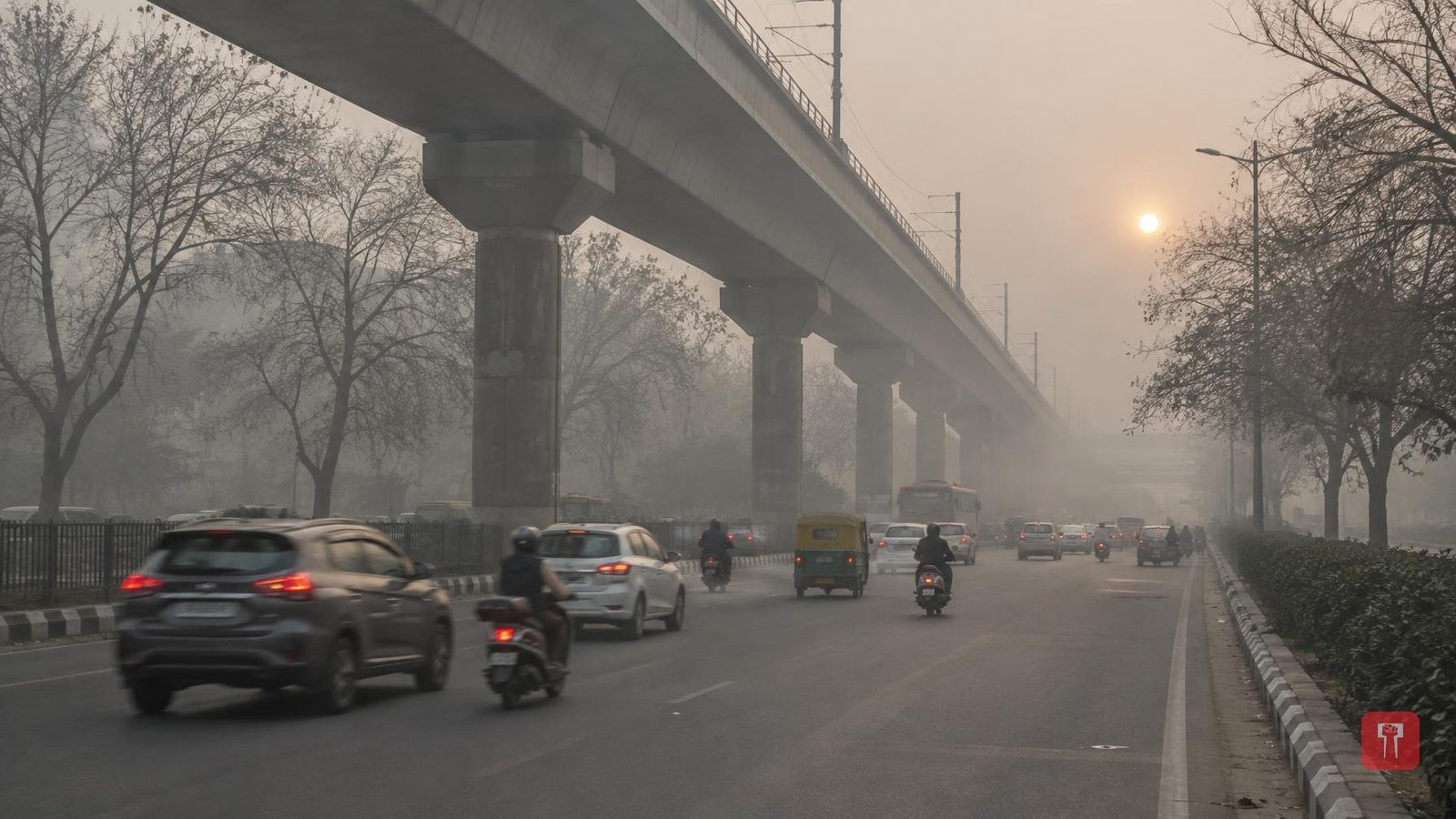
The deadly air pollution that engulfs Delhi every year is not caused only by vehicle exhaust, factory emissions or other human factors, but is also heavily influenced by changes in weather, a new study has found. Notably, the effect of changing temperature or weather conditions on pollution levels does not show up immediately, with the impact of certain weather factors appearing with a delay of as much as 51 hours. Scientists at the Indian Institute of Tropical Meteorology (IITM), Pune, have reached this key conclusion.
The study was published in the journal Environmental Science: Atmospheres. IITM's lead researcher Vivek Singh and his colleagues studied Delhi's weather and PM 2.5 pollution between 2017 and 2025. During this period, they examined the relationship between PM 2.5 levels and factors such as temperature, humidity, rainfall, wind speed, solar radiation, surface pressure and boundary layer height, the height of the lower layer of the atmosphere.
According to the study, the effect of a change in temperature on PM 2.5 can take up to 51 hours to show up. The effect of humidity and wind speed also appears after a few hours. This delay was found to be three hours for temperature, four hours for humidity, five hours for rainfall, and around 11 hours for wind speed.
When the boundary layer height is low, pollutant particles do not get enough space to disperse into the upper atmosphere. In winter this height falls below 500 metres, trapping pollutant particles close to the ground and causing PM 2.5 levels to rise sharply. Low wind speed also increases the accumulation of pollutants, while strong wind helps disperse them.
Pollution levels in Delhi were found to be highest between 6 am and 9 am, and between 8 pm and 11 pm. Between November and January, PM 2.5 levels were often above 200 micrograms per cubic metre, reaching a maximum of 879.6 micrograms per cubic metre during the study period. In contrast, during the monsoon, rain and wind bring the level down to below 50.
Over the nine years from 2017 to 2025, Delhi's average PM 2.5 level has declined gradually but steadily, from an average of 127.7 in 2017 to 80 in 2025. With this link between weather and pollution now clearer, the study could help make future pollution forecasting and early warning systems more accurate.
