

Farmer front must reach every village and solve their problems: Sudhir Mungantiwar
MLA Sudhir Mungantiwar tells a district-level Kisan Morcha meet in Chandrapur that the farmers' body must take farmers' problems to the government and ensure they are resolved.
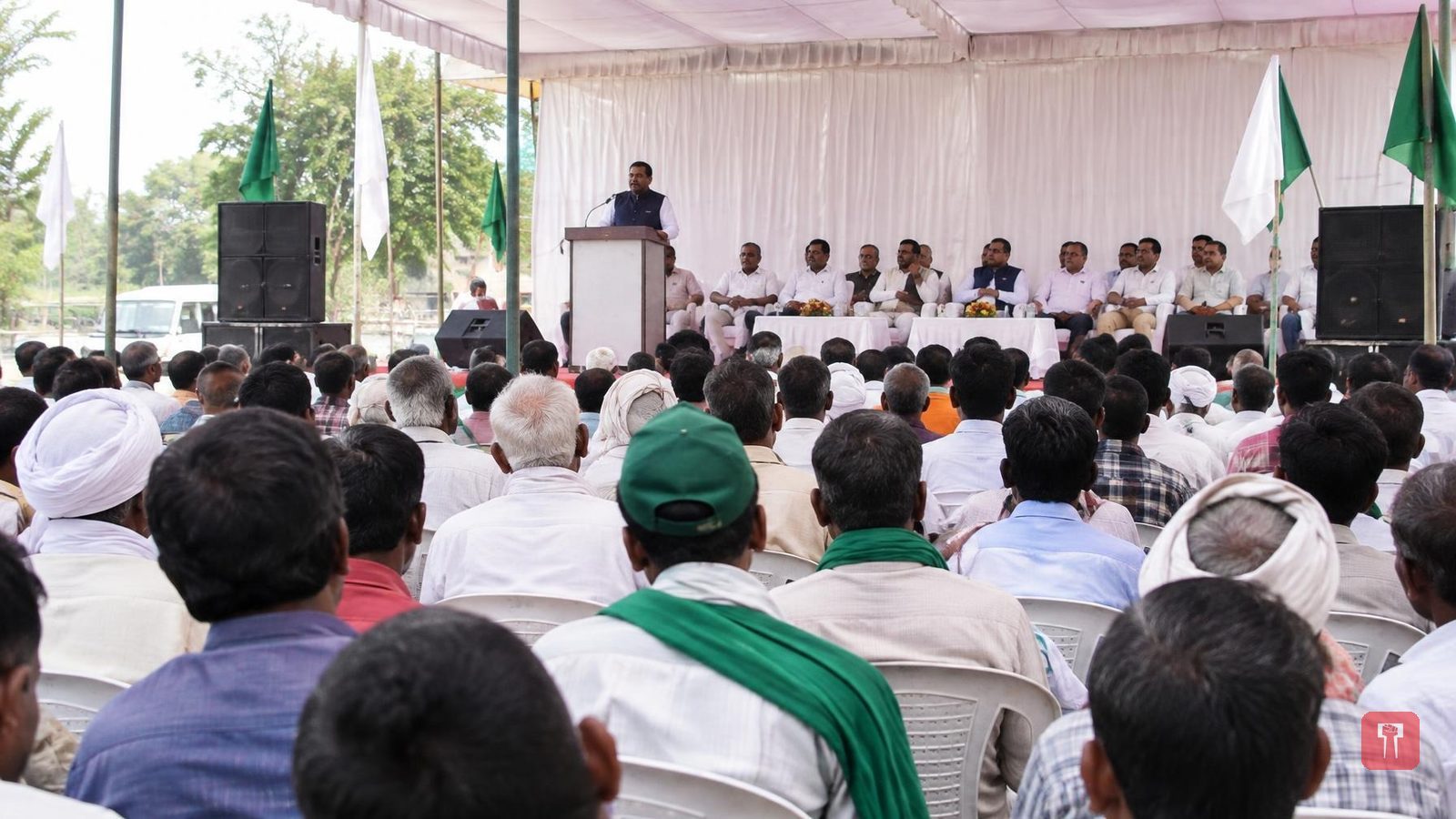 Images are not validated/verified
A farmer's problems cannot be seen only through the lens of schemes and statistics; his pain has to be understood by going to his field. The Kisan Morcha should reach village to village, right up to the field bund and to the last farmer, and become his voice. Making the farmer's problem its own and pushing it to the government with strength, and getting him justice, is the real responsibility of the Kisan Morcha, said former state finance minister and MLA Sudhir Mungantiwar.
The Bharatiya Janata Party's Chandrapur (Rural) district unit organised a district-level Kisan Morcha conference at Dr. Shyama Prasad Mukherjee Library in Chandrapur. The event was attended by MLA Devrao Bhongle, Kisan Morcha state president Ramkrishnaji Vetal, convenor and Agricross head Ravi Nigude, Kisan Morcha general secretary Santosh Deshmukh, Ranganath Solanki, Vijay Pidurkar, Ravi Chahare, Agricultural Prices Commission member Bandu Gaurkar, Devanand Mahajan, Pramod Kadaskar and Anil More, along with a large number of taluka presidents and office-bearers of the district Kisan Morcha.
At the conference, Mungantiwar gave detailed guidance on the Kisan Morcha's future role regarding farmers' problems, building the organisation and taking government schemes to farmers. He first wished the farmers present a happy Bail Pola, and, extending greetings for the upcoming Ganeshotsav, prayed at the feet of Lord Ganesh that no crisis or obstacle should befall farmers.
Mungantiwar said "Jai Jawan, Jai Kisan" is not just a slogan for all of us. It is our responsibility to keep farming and the farmer, the profession that carries the biggest responsibility of feeding the country, at the centre. Underlining the wide importance of agriculture in Maharashtra, he said the state has 1.71 crore Satbara (land record) holders, and crores of people depend directly or indirectly on farming for their livelihood. Farming is therefore not just a business but the backbone of society's economic life, he said.
He said that one who serves one's mother is called a good son, and one who serves the soil is called a farmer. The plough is one of the world's most important discoveries, one that changed human life; after its discovery, man settled in one place and farming became the first occupation. But he regretted that in today's race for progress, farming is becoming the last occupation people choose. Citing the old saying "farming is the best, trade is middling, a job is the lowest", he said farming once held the highest status, but today the situation has reversed. The farmer works hard, but his organised strength needs to grow. "Instead of blaming their fate and staying silent, farmers should organise and raise their voice for their problems," Mungantiwar said.
Raising the question of whether farmers are satisfied even though schemes have reached them, Mungantiwar said that if the Kisan Morcha is to lead farmers, the organisation must be built the right way, reaching the last village of Chandrapur district. There are many government schemes for farmers, but there must be reflection on how successful the effort to actually deliver them to farmers has been, he said, adding that there should also be an assessment of whether the farmer is truly satisfied after a scheme reaches him and whether his difficulties have actually been resolved. He also pointed to delays in farmers receiving the benefits of schemes. "There are many tolls on the road that leads farmers to schemes. Those tolls breed more resentment than joy in his mind. If a tractor is bought on subsidy but the subsidy arrives only years later, the very purpose of the scheme is weakened," he said, adding that the benefits of schemes must reach farmers in a manner that is easy, transparent and on time.
Appealing to the Kisan Morcha to play an active role on various farmer issues, Mungantiwar said the issue of farm loan waivers has been raised in the state assembly, and there has also been consistent pressure for a bonus on paddy. The paddy farmer is a poor farmer, so the organisation must work to get him justice, he said. He added that if there is anyone who can awaken Maharashtra's self-respect, it is the farmer, so the farmers' organisation must be made strong, along with its ideological platform.
Expressing the hope that Kisan Morcha state president Ramkrishnaji Vetal would begin touring every corner of Maharashtra, Mungantiwar suggested holding a Kisan Morcha state executive meeting in Chandrapur. He also appealed for a two-day farmers' workshop to hold in-depth discussions on various issues related to agriculture. He said the state executive meeting to be held in Chandrapur should prepare well-studied proposals to take farming forward, proposals that should guide farmers, the agriculture department and the agriculture ministry. He appealed that farmers' problems should be conveyed to the government not merely on paper or in meetings, but by going village to village, talking directly to farmers and learning their difficulties.
Citing the history of the Bharatiya Janata Party's farmer movement, Mungantiwar recalled the leadership of Gopinath Munde. Munde had become the party's Maharashtra state president at the age of 36. Mungantiwar said that with the conviction that farmers must feel the party is their own if it is to move forward, the BJP's first farmers' struggle yatra was launched under his leadership in 1986 from the Kalaram temple in Chandrapur. Noting that Chandrapur's soil carries this tradition of farmer movements and organisational struggle, he appealed that the Kisan Morcha build, from this same soil, work that gives new direction to today's farmers' questions.
Saying that awareness must be created among farmers with the spirit that "whether we remain or not, India must remain", MLA Sudhir Mungantiwar appealed to the Kisan Morcha to work for farmers keeping sensitivity, study, organisation and direct action at the centre.
