

Even Ganeshotsav fails to lift flower prices, farmers left worried
Despite heavy demand during Ganeshotsav, flower growers in Purandar taluka are getting far lower prices than expected, barely covering costs.
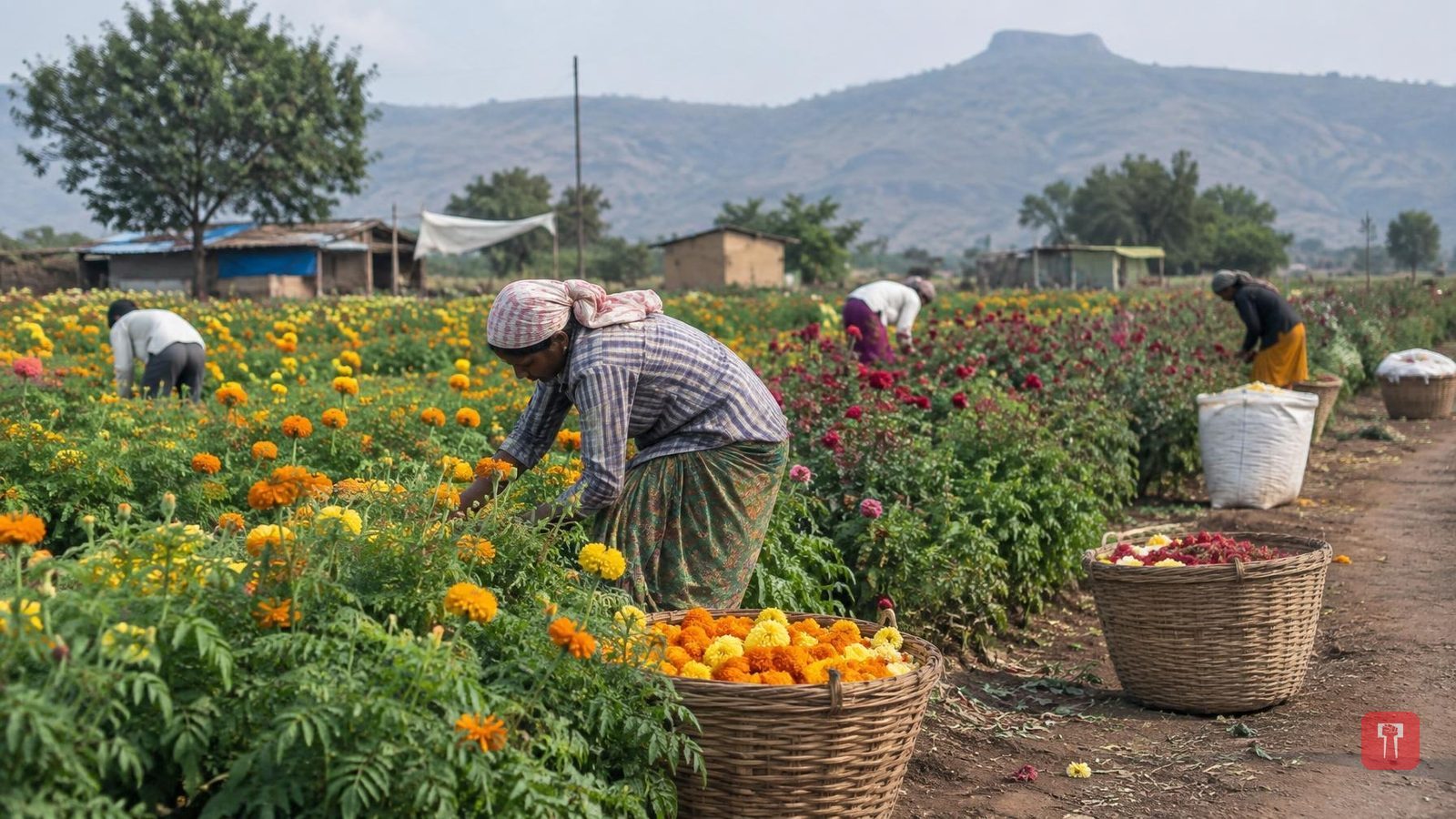
Ganeshotsav is currently underway in Saswad, and demand for flowers usually stays strong through the major festivals that follow it, including Pitru Paksha, Navratri and Diwali. Anticipating this, farmers had cultivated various types of flowers on a large scale. Flowers are now being harvested, and while both arrivals and demand in the market are good, farmers are not getting the prices they had hoped for, raising the question of how they will recover their costs.
Despite putting in so much effort and producing so much, farmers are not earning as much as they expected, leaving them in difficulty. Keeping the festival season in mind, farmers in Purandar taluka grow large quantities of roses, gerbera and mogra, along with several varieties of marigold such as bijli and kapri. This year the weather did not favour farmers either, with low rainfall forcing them to struggle to save their kharif crop. Even so, farmers worked hard to prepare their crop, and it is standing firm despite the shortage of water. In some places bajra crops are preparing to head, while everywhere farmers are harvesting flowers such as kapri, marigold, bijli and terda.
Prices had fallen to their lowest just before Ganeshotsav. Farmers can still be seen in their fields harvesting various flowers. They had hoped that Ganeshotsav would bring good prices and, with it, good earnings. But market conditions turned out to be quite different from what they expected, with prices coming in much lower than anticipated, leaving farmers unsure whether they will even cover their expenses. Every year during Ganeshotsav, marigold and other flowers fetch at least 100 rupees per kilogram. But this year prices are not even reaching 50 rupees a kilogram. Even with Ganeshotsav right around the corner, the lowest prices were as low as 20 to 30 rupees. Prices have risen only slightly since then, by 20 to 30 rupees, to around 50 to 60 rupees per kilogram now.
If farmers account for all the labour and expenses involved, from sowing the flowers to harvesting and then transporting them to market, nothing is left over. To cover harvesting costs and keep some money in hand, many farmers are relying on family members to do the work themselves, while others have to bring in hired labourers. A labourer has to be paid at least 300 rupees in wages. At that rate, even if five people harvest flowers all day, the earnings do not cover the cost. Flower grower Madhukar Kumbharkar said that prices of at least 80 to 100 rupees are needed for costs to be covered.
