

Mahalakshmi-Gauri and Ganpati traditions trace journey from scarcity to abundance
Maharashtra's Mahalakshmi-Gauri and Ganpati rituals, from grain-filled idols to a six-taste feast, echo humanity's shift from scarcity to farming and prosperity.
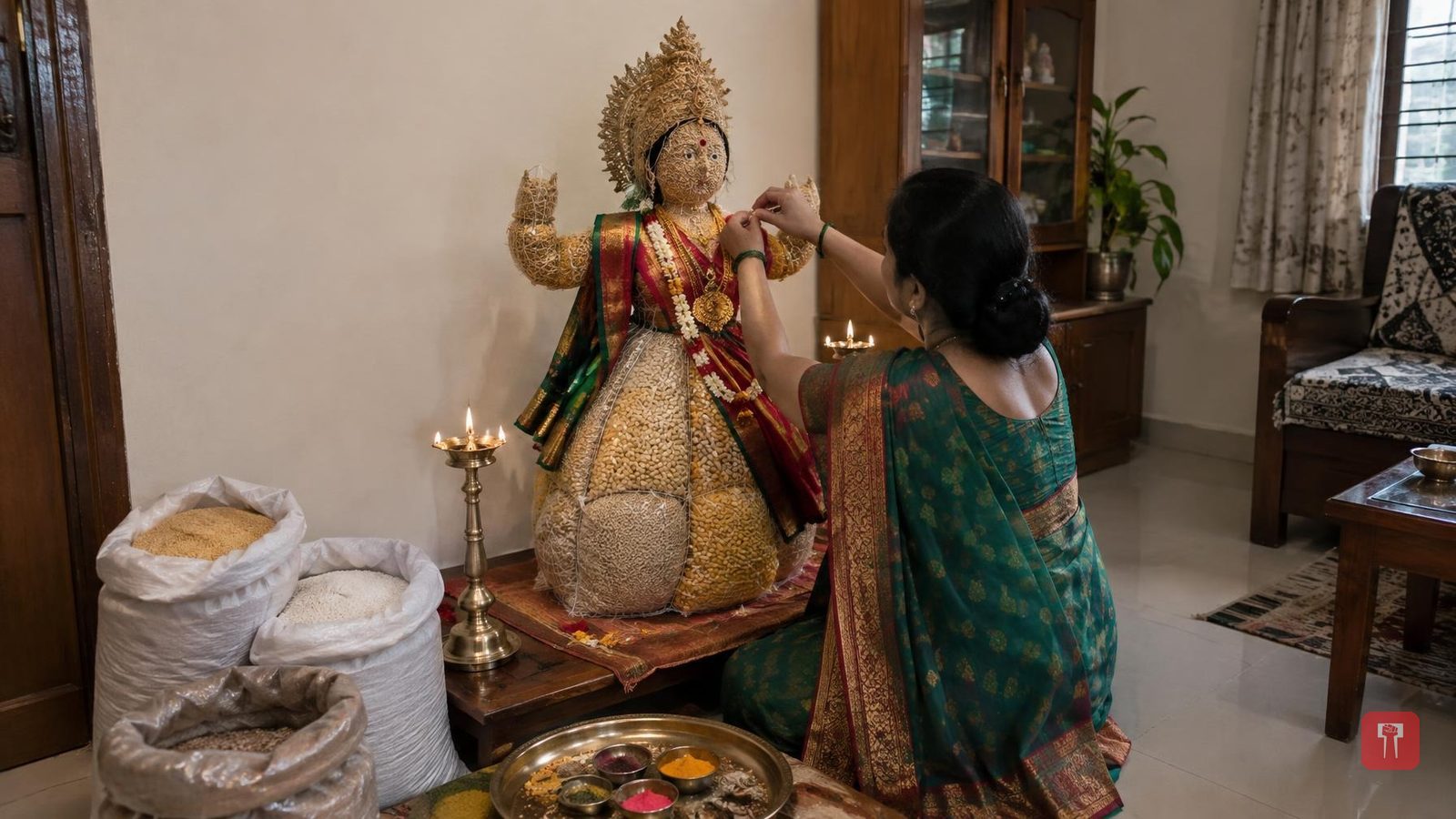
Nagpur: As the monsoon reaches its final stretch in the month of Shravan, preparations begin across Maharashtra for Ganpati and the Gauri festival that follows soon after. The months of Ashadha and Shravan bring plentiful rain and greenery, a cycle that culminates with the grand installation of Ganpati on Bhadrapada Shuddha Chaturthi. Soon after, households across Maharashtra observe the traditional festival of Mahalakshmi, or Jyeshtha Gauri.
The festival is observed differently in different households. In many homes, Mahalakshmi is invoked on the Anuradha nakshatra, worshipped on the Jyeshtha nakshatra, and bid farewell on the Mool nakshatra. Some families instead observe the festival according to the dates of Bhadrapada Shuddha Saptami, Ashtami and Navami.
An interesting aspect of the tradition is fashioning the goddess from a frame called "kothale". A hollow structure is filled with grains such as jowar, wheat or rice to form the goddess's body, after which arms and legs are attached, and the goddess is then adorned with traditional clothes and jewellery.
It is believed that the goddesses arrive at their maternal home with their children, so households prepare an elaborate feast without onion and garlic, incorporating all six tastes, bitter, pungent, sour, sweet, salty and astringent. In parts of Vidarbha and Marathwada, this is called "Mahalakshmiche jevan". The traditional feast can include sixteen types of vegetables, sixteen chutneys and salads, tamarind panchamrit, puran poli, lentil vadas, kathali, jowar ambil and varan-bhat. Grains such as wheat, rice and jowar are also placed in large quantities before the goddesses.
Beyond its ritual significance, this abundance can also be seen as a powerful illustration of the agricultural revolution and its impact on human civilisation.
The journey from hunting and foraging to farming marked a major shift in human history. Once humans learned to till land, sow seeds, grow crops and store grain for later use, they achieved a stability never known before. Agriculture reduced the pressure of constantly wandering in search of food, and people began settling in one place. With food security assured, human society could devote more attention to knowledge, art, technology, trade and other intellectual pursuits. The Mahalakshmi tradition reflects this very contrast, scarcity, hunger and instability on one side, and food security, prosperity and the flourishing of human potential on the other.
In this tradition, the words Jyeshtha and Kanishtha carry specific meanings, Jyeshtha meaning elder and Kanishtha meaning younger. The Shri Sukta expresses the wish to banish Alakshmi, associated with hunger, thirst, impurity and want: "Kshutpipasamalaam Jyeshthaam Alakshmim Nashayamyaham. Abhutimasamriddhim cha sarvaam nirnuda me grihat." This verse is a prayer to remove hunger, scarcity, stagnation and lack of prosperity from the home. The concept of "abhuti" is particularly significant here, and can be linked to a state in which growth and progress come to a halt. In this way, Jyeshtha Alakshmi symbolises the condition of scarcity and stagnation that humanity has sought to leave behind.
The Padma Purana mentions Alakshmi, who is said to have emerged before the goddess Lakshmi during the churning of the ocean. She is associated with conflict, discord and inauspicious circumstances, and is called "Kalahapriya", meaning one who is fond of quarrels. In parts of South India, Alakshmi is depicted with a broom, a crow on her flag, and a donkey as her mount. In the Mahalakshmi tradition, Jyeshtha Alakshmi is invoked for this reason with the prayer that scarcity and discord stay away from the home, while Kanishtha Gauri Lakshmi is welcomed so that prosperity remains throughout the year.
Gauri, considered a form of Parvati, is traditionally associated with the monitor lizard, known for its strong grip. This can be seen as a symbol of the importance of maintaining a firm hold on the process of growth and progress. In many households, Ganpati is installed between Jyeshtha and Kanishtha Gauri, with Ganpati traditionally regarded as the remover of obstacles and the giver of wisdom and knowledge. This entire arrangement and manner of worship can be seen as depicting humanity's progress from scarcity and hardship towards prosperity, powered by wisdom, cooperation, agricultural yield and collective effort.
This symbolism also connects to the larger message of the story of the churning of the ocean. When opposing forces remain locked only in hostility and conflict, discord alone prevails. But when differences are channelled into collective effort, that same churning yields Lakshmi, the symbol of prosperity. Seen this way, the traditions of Mahalakshmi-Gauri and Ganpati preserve the memory of one of humanity's greatest transformations, the journey from food scarcity and a nomadic life to farming, stability and prosperity.
The grain-filled idols, the elaborate feast and the festive glow are not merely displays of abundance. They can be seen as a celebration of the civilisation that learned to secure its food, build community, and create a better and more prosperous life through human intelligence. Through the worship of Jyeshtha Gauri, Kanishtha Gauri, Mahalakshmi and Ganpati, Indian tradition offers a vivid glimpse of this journey from scarcity to prosperity, and is a reminder that prosperity comes only when human intelligence and collective effort overcome hardship.
