

Gondwana supercontinent covered 80 percent of Earth's land, new study finds
A new study using AI and rock samples shows Gondwana covered far more of Earth's landmass than previously thought, and links its formation to the rise of complex life
 Images are not validated/verified
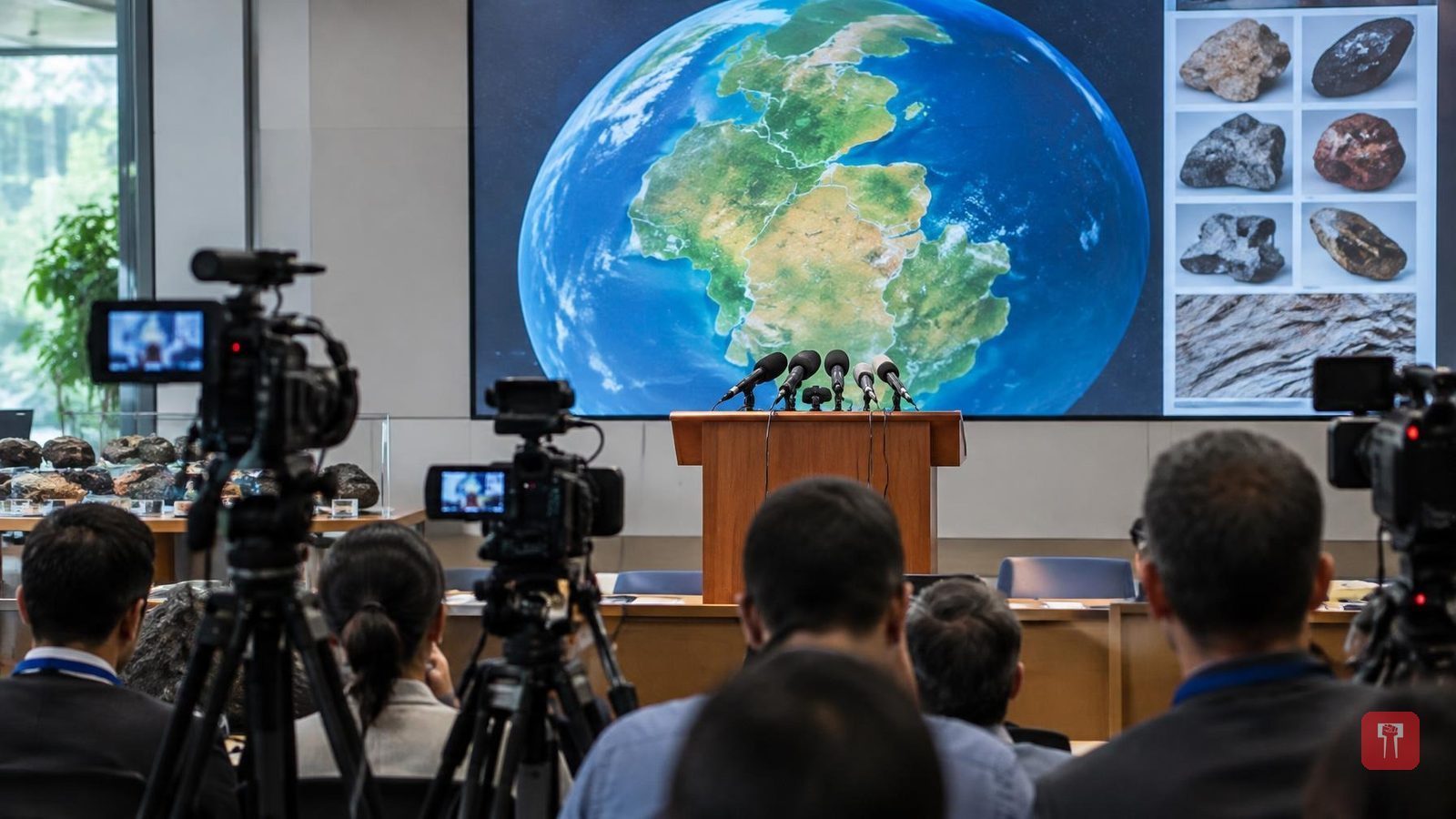
Millions of years ago, several large supercontinents formed on Earth and then broke apart. One of the most significant of these landmasses was Gondwana. The Indian subcontinent, Africa, South America, Antarctica and Australia were all once part of Gondwana. A research paper recently published in the journal Science Advances has made a startling and revolutionary revelation about the structure of Gondwana.
Geologists have found important evidence about Gondwana's old boundaries. Until now, scientists around the world believed that Gondwana covered only about two-thirds of the total landmass of that era, roughly 65 percent. But new research has made it clear that the Gondwana supercontinent, which existed between 800 million and 500 million years ago, covered a full 80 percent of the total landmass of Earth.
This major finding has been made by an international scientific group called Deep-Time Digital Earth. A team led by Professor Tao Wang of the Chinese Academy of Geological Sciences and Professor William Collins of Curtin University collected more than 25,000 samples of ancient magmatic rocks from around the world.
Due to geological movements, fragments of Gondwana were scattered across different continents and mountains over hundreds of millions of years. To determine when and under what conditions these rocks were formed, researchers used artificial intelligence and advanced database technology. AI helped determine the actual location of these rocks and a digital map of the ancient Earth was prepared.
To build this map, scientists used isotopes of the elements samarium and neodymium. These isotopes act as a kind of "chemical signature" or "fingerprint" for Gondwana's original rocks. Collins, the lead author of the research, described this samarium-neodymium isotopic map as a "time machine" that takes researchers into the past. It was this fingerprinting technique that made it possible to identify 500-million-year-old rocks hidden within mountains that were formed only 20 million years ago.
The most important aspect of this research is that it has revealed a direct link between the formation of Gondwana and the development of life on Earth. About 538 million years ago, Earth witnessed the "Cambrian explosion," a period during which a wide variety of complex and larger organisms suddenly began to emerge. Before this, only simple microorganisms had existed on Earth for billions of years.
During the formation of the Gondwana supercontinent, intense geological activity occurred across about 79 percent of Earth's surface, creating an ancient "ring of fire". Continuous volcanic eruptions along this ring of fire released large quantities of gases such as carbon dioxide and water vapour into the atmosphere. This warmed an Earth that had been extremely cold, and this changing climate created conditions in which complex life could flourish.
